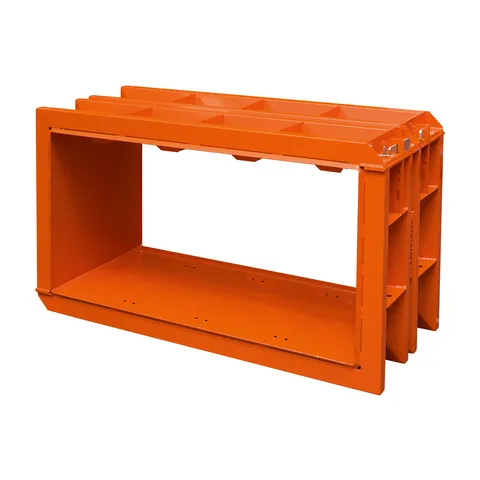
BETONBLOCK®: THE RIGHT CONCRETE BLOCK MOULD FOR EVERY PROJECT
Betonblock® has been the market leader in concrete block moulds for over 25
years. Betonblock® has a comprehensive range of concrete moulds, accessories
and peripheral equipment and serves more than 9,500 loyal customers in over 90
different countries.
In addition to concrete block moulds, Betonblock® also sells the following
moulds:
What are the advantages of Betonblock® interlocking concrete moulds?
Betonblock® moulds are made of high-quality S355 steel and are powder-coated
to create a hard scratch and impact-resistant layer. This coating also
prevents the steel from rusting and comes in many different colours. The
moulds are built to last and will continue to deliver for at least 10 years.
The interlocking Concrete Block® moulds feature a unique closure that ensures
that the moulds are easy to use and dimensionally stable, so you can keep
producing identical stackable concrete blocks year in year out. Our
high-quality moulds produce uniform blocks that fit together seamlessly and
create sturdy structures. Many Betonblock® customers have been making blocks
with the same mould(s) every day for a decade without any of the moulds
warping.
Wide range of stackable concrete block moulds
Betonblock®’s interlocking concrete block moulds come in many different
shapes and sizes. We carry moulds with a length of: 120 cm, 150 cm, 160 cm,
180 cm, 200 cm and 240 cm. Moulds come in the following widths and depths: 30
cm, 40 cm, 60 cm and 80 cm.
Our interlocking concrete block moulds at a glance:
● Basic: our signature, most widely
used mould for stackable concrete blocks
● Flat top (00): a studless concrete
block
● Round (R): a concrete block with a
rounded corner
● Slope (45): a concrete block with a
slope
● Stairs (S): a stepped concrete
block
● Top (T): the top block
● Wide base (W): a concrete block
with a wide base
Start casting right away
Betonblock®'s robust steel moulds come as a full kit, including mould opener,
so you can start producing interlocking concrete blocks right away. Tip! Spray
the mould with Betonblock® formwork oil prior to casting. If you do not apply
the oil first, the mould may not release the concrete. On top of that, the oil
also helps keep the mould in tip-top condition, so it will last longer.
Less than €1 a block!
Betonblock® moulds are high-quality products that are built to last, making
them suitable for more than decade’s worth of daily usage. Based on the
following calculations: 250 days per year (excluding weekends and holidays) x
10 years = 2,500 concrete blocks from one mould. Our best-selling concrete
interlocking block mould, Basic 160x80x80, costs €1,675. Resulting in a grand
total of: € 0.67 for each concrete block!
A bigger bottom line with Betonblock® moulds
Making money with Betonblock®’s interlocking concrete block moulds is easier
than you might think. All you have to do is reuse concrete leftovers! If you
accidentally over-order concrete for a project, you can put the leftover
concrete - which has already been paid for - to good use. Simply pour the
leftover concrete into a Betonblock® mould and sell the
stackable concrete blocks
for well over cost! Using your leftover concrete does not just good for your
bottom line, but also helps contribute to waste reduction and makes the world
a more sustainable place.
Special requirements for concrete block moulds?
With our ample experience, Betonblock® knows all the ins and outs of the
market, allowing us to actively respond to supply and demand and always come
up with a bespoke solution. Looking for a mould in an odd size or different
colour? The options are (almost) endless at Betonblock®. Send your question,
idea and/or design to
info@betonblock.com
and our specialists will get back to you with sound, tailor-made advice.
Frequently Asked Questions About Concrete Block Moulds
Would you like to produce your own concrete blocks but still have questions about choosing the right mould, pouring concrete, or using and maintaining the equipment? Below, you will find answers to frequently asked questions about BETONBLOCK® concrete block moulds.
Is it cheaper to make your own concrete blocks?
Producing your own concrete blocks can be very cost-effective, especially if you regularly need concrete blocks or can reuse leftover concrete. A BETONBLOCK® mould is designed for many years of intensive use. The more frequently you use the mould, the lower the cost per concrete block produced. In addition, you can turn surplus concrete into usable concrete blocks instead of disposing of it as waste.
What type of concrete should I use in the moulds?
The most suitable concrete mix depends on the intended application and the required properties of the concrete block. These include, for example, the necessary strength, durability and conditions in which the blocks will be used. Always ensure that the concrete mix is suitable for your specific application. We see that concrete batching plants either produce fresh concrete specifically for making blocks or use leftover concrete from a concrete mixer truck. Many people also make their own concrete for the blocks using water, sand, gravel and cement.
How long should I wait before removing the mould?
A concrete block can generally be demoulded after approximately 24 hours. The exact timing depends on factors including the concrete mix, concrete temperature, ambient temperature and weather conditions. We therefore recommend a guideline of 24 to 72 hours before demoulding and moving concrete blocks. Have you incorporated lifting anchors into the concrete block? If so, we recommend waiting at least 48 hours before lifting the block using these anchors, and only doing so once the concrete has achieved sufficient strength.
When constructing higher walls with concrete blocks, it is common to wait at least one week to allow the concrete to continue curing and develop sufficient strength.
Before demoulding, lifting or stacking, always check that the concrete has achieved sufficient strength for the intended operation.
What size or type of concrete block mould do I need?
The size and type of concrete block mould you need mainly depend on the intended application, the required dimensions of the concrete blocks and the structure you want to build.
BETONBLOCK® offers concrete block moulds in various dimensions and designs, including Standard, Flat Top, Round, Sloped, Stair, Top Course and Wide Base. By combining different mould types and inserts, you can produce concrete blocks for a wide range of applications, structures and finishes.
Common and popular dimensions include 160x80x80 cm, 180x60x60 cm and 150x60x60 cm. These large concrete blocks are frequently used to construct strong and higher retaining walls, storage walls and partition walls.
In addition to the dimensions, you can adapt the design to your project. For example, if you want to create corners or curves in a wall, you can use a Round design. For a flat upper surface, choose a Flat Top mould or, depending on the mould type, use a Flat Top insert in a standard interlocking mould with studs. Other designs and inserts allow you to produce sloping walls, stairs, wider base blocks and various finishes.
The most suitable combination depends on the dimensions and configuration of your structure. Our advisers will be happy to help you determine in advance which mould sizes, types and any additional inserts you need for your project.
Can I use leftover concrete in the concrete block moulds?
Yes, leftover concrete is highly suitable for use in BETONBLOCK® moulds. Concrete remaining after a pour or construction project can be used to produce new concrete blocks. This allows you to turn leftover concrete into a valuable, reusable product, reduce concrete waste and make better use of every cubic metre of concrete. Leftover concrete can be used effectively for standard stackable concrete blocks, such as interlocking concrete blocks, provided the concrete is still sufficiently workable and achieves the quality and strength required for its intended application. You can also use concrete reinforcement when pouring leftover concrete in several layers to improve the bond between the layers. Higher requirements apply to structural elements such as L-shaped elements and retaining walls. For these applications, we recommend using concrete with a controlled composition, quality and strength suitable for the relevant structural application.
Always remember that it is not only the mould but, above all, the intended application of the finished concrete product that determines the concrete specifications and strength requirements that must be met.
What types of concrete block moulds are available?
In addition to different dimensions, several shapes and designs are available. The range includes Standard for conventional concrete blocks, Flat Top for blocks without studs, Round for flexible wall angles, Sloped for an inclined finish, Stair for stair-shaped blocks, Top Course for the uppermost blocks and Wide Base for blocks with a wider base.
How do I prepare the concrete block mould?
Make sure the mould is clean and positioned on a level, stable surface. You can use the BETONBLOCK® casting table for this purpose. Before pouring the concrete, spray the inside of the mould with BETONBLOCK® mould release oil. This reduces adhesion between the concrete and the mould, makes it easier to demould the hardened block and helps protect and maintain the mould at the same time.
How do I fill and compact the concrete to prevent air bubbles, voids and weak spots?
Fill the mould evenly and ensure that the concrete is properly compacted. You can use a concrete poker vibrator for this purpose. This removes as much trapped air as possible and helps the concrete fill corners and other hard-to-reach areas of the mould. The appropriate compaction method depends on the concrete mix used and the desired final result.
How long does a concrete block take to cure?
A concrete block can generally be demoulded after approximately 24 hours. The exact timing depends on factors including the concrete mix, concrete temperature, ambient temperature and weather conditions. We therefore recommend a guideline of 24 to 72 hours before demoulding and moving concrete blocks. Have you incorporated lifting anchors into the concrete block? If so, we recommend waiting at least 48 hours before lifting the block using these anchors, and only doing so once the concrete has achieved sufficient strength.
When constructing higher walls with concrete blocks, it is common to wait at least one week to allow the concrete to continue curing and develop sufficient strength.
Before demoulding, lifting or stacking, always check that the concrete has achieved sufficient strength for the intended operation.
When is a concrete block ready for stacking, use or transport?
A concrete block must achieve sufficient strength before it can be moved, stacked or subjected to loads. When this is possible depends on the concrete mix, the curing conditions and the intended final application. The fact that a block can be removed from the mould does not automatically mean that it can immediately withstand its full intended load. We therefore recommend a guideline of 24 to 72 hours before demoulding and moving concrete blocks. Have you incorporated lifting anchors into the concrete block? If so, we recommend waiting at least 48 hours before lifting the block using these anchors, and only doing so once the concrete has achieved sufficient strength. When constructing higher walls with concrete blocks, it is common to wait at least one week to allow the concrete to continue curing and develop sufficient strength.
How do I maintain concrete block moulds?
Clean the mould regularly immediately after use with a pressure washer and remove concrete residue before it builds up. Using mould release oil not only helps with demoulding but also contributes to maintaining the mould. Regularly inspect the locking mechanisms and other components. Proper maintenance helps you produce dimensionally accurate concrete blocks using the same mould for many years.
How long does shipping of concrete block moulds take?
Delivery time depends on your location, the products selected, availability and the transport company. Once your payment has been received, your order is usually ready for transport on the next working day. Shipping then takes an average of 2 to 5 working days, depending on the destination.
Would you like to know approximately when your order will be delivered? Contact BETONBLOCK® for an up-to-date delivery estimate.
Where are BETONBLOCK® moulds manufactured?
Our BETONBLOCK® moulds are manufactured 100% in our own factory in the Netherlands. We want to determine not only how our moulds are designed but also maintain complete control over how they are manufactured. From steel processing and automated welding to assembly and quality control, we manage the entire production process from start to finish. Using modern machinery and skilled professionals, we continuously monitor the dimensional accuracy, welds, material selection, finishing and quality of every mould.
By keeping production in our own hands, we can continuously monitor and improve our quality.
Would you like to see for yourself how a BETONBLOCK® mould is manufactured? You are very welcome to visit our factory in the Netherlands. Contact us to arrange an appointment.