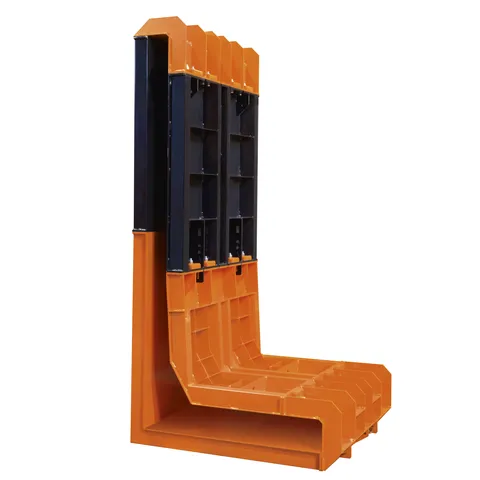
BETONBLOCK® RETAINING WALL MOULDS; NEW ARRIVAL
Retaining wall moulds are the latest addition to the Betonblock® concrete
mould range. Although it is a relative newcomer, this L-shaped mould is
already incredibly popular and produces a one-piece retaining wall. These
L-shaped elements are used all over the world because concrete walls can
withstand all weather conditions, such as snow, ice and rain, but also cope
with extreme heat. Because of their special shape and durability, retaining
walls are highly versatile.
Projects with retaining walls:
· Flood defence
· Storage facilities
· Garden and yard fencing
· Splash and noise barriers
· Bridging height differences
· Quay walls and walls along
canals and ponds
The advantages of Betonblock® retaining wall moulds
Betonblock® has been the market leader in steel moulds for concrete solutions
for over 15 years, and for good reason. Our high-quality moulds are built to
last and will continue to deliver for at least ten years, even if they are
used to cast retaining walls day in, day out. In average conditions, concrete
takes about 24 hours to cure, so all you need is one mould to produce a new
retaining wall every day. For faster production time and larger projects, we
recommend buying multiple moulds.
What sizes do Betonblock® retaining wall moulds come in?
Betonblock® retaining walls are available in various sizes and designs. The
basic retaining wall mould is 100x100x100 cm, which can be modified with the
retaining wall extension set to create a retaining wall mould measuring
100x100x200 cm. The extension set is also sold separately, so you can always
extend your 1 m retaining wall mould to a 2 m version at a later date. We also
carry a medium mould: 100x100x150. Ask our staff about the possibilities.
What retaining wall accessories does Betonblock® carry?
To produce a retaining wall, the L-shaped mould has to lie on its side.
Inserting cast-in anchors makes it easier to tilt and manoeuvre the concrete
block before moving it to its destination. Betonblock® also has special
retaining wall clamps with a maximum capacity of 3,000 and 5,000 kg,
respectively. We also recommend ordering an oil pump and formwork oil if you
do not already have them.
In addition to retaining wall moulds, Betonblock® also sells the following
moulds:
Retaining walls made from concrete leftovers
Concrete plants are becoming increasingly aware of the environmental impact of
concrete and have started using leftover concrete to reduce emissions.
Betonblock®'s concrete moulds let them do just that. Not only can the
resulting retaining walls be sold for a profit, but using concrete leftovers
also helps avoid concrete disposal costs. Kill two birds with one stone by
reusing raw materials (circular economy) and reducing your environmental
footprint at the same time.
One-stop-shop for concrete moulds
Looking for different types of concrete moulds? Betonblock® is the place to
be! Betonblock®. supplies concrete block moulds, concrete slab moulds,
retaining wall moulds, barrier moulds, tetrapod moulds and accessories, all so
you can start casting immediately. Need help on how to start making concrete
blocks?
Check out the instructions for pouring concrete in concrete moulds here.
Bespoke
If you have an idea or design for a concrete mould that we do not carry yet?
Feel free to contact us an explore the options. We have ample experience with
bespoke solutions within our field: the possibilities are endless. Fill in the
contact page; our staff will gladly tell you more.
Frequently asked questions about retaining wall moulds
With BETONBLOCK® retaining wall moulds, you can produce L-shaped concrete elements for a wide range of applications. The moulds are available in different heights and can partly be expanded modularly. Concrete retaining walls can be used, among other things, as water barriers, for storage facilities, site boundaries and to accommodate differences in level. Below, we answer the most frequently asked questions about retaining wall moulds.
What sizes of retaining wall moulds are available?
BETONBLOCK® offers retaining wall moulds in different heights. The range includes, among others, versions measuring 100x100x100 cm and 100x100x200 cm. BETONBLOCK® also states that an intermediate size of 100x100x150 cm is available. Which size is suitable depends on the application and the required height of the retaining wall.
Can I later extend a retaining wall mould to a greater height?
Yes. A retaining wall mould with a height of one metre can be extended to a height of two metres using the modular extension set. The extension set is also available separately. This allows you to start with the lower mould and expand your production options later without immediately purchasing a completely new retaining wall mould.
What applications are concrete retaining walls suitable for?
Concrete retaining walls can be used for a wide range of projects. BETONBLOCK® mentions, among other things, water barriers, storage facilities, garden and property boundaries, splash and noise barriers, accommodating differences in level, and quay walls or walls along canals and ponds. Which version is most suitable depends on the requirements of the specific project.
How quickly can I produce a new retaining wall with one mould?
According to BETONBLOCK®, concrete takes approximately 24 hours to harden under average conditions. This makes it possible to produce approximately one new retaining wall per day with a single mould. The actual curing time may vary due to factors including the concrete composition, temperature and production conditions. For higher production capacity, BETONBLOCK® recommends using multiple moulds.
Which accessories and lifting equipment do I need to produce and move a retaining wall?
The L-shaped retaining wall is cast lying on its side. By incorporating anchors into the concrete during casting, the hardened retaining wall can subsequently be tilted, positioned and transported. BETONBLOCK® also offers special retaining wall clamps with maximum lifting capacities of 3,000 kg and 5,000 kg. Release oil and an oil pump can also be useful when preparing and using the mould.
Can I use leftover concrete to produce retaining walls?
It is possible, but BETONBLOCK® does not recommend it for a retaining wall. Concrete quality is particularly important for a relatively thin retaining wall. BETONBLOCK® mentions the production of concrete elements as a way to reuse leftover concrete. Instead of disposing of leftover concrete, it can be used to make concrete retaining walls. This allows raw materials to be reused and leftover concrete to be converted into new concrete elements that can be used or sold.